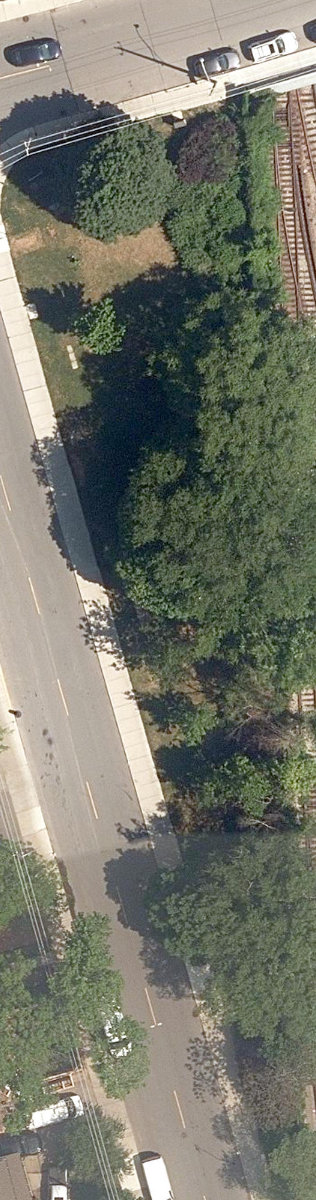
Fiona Nelson Parkette
Urban Plaza, middle of the pack overall (score 35, rank ~52th percentile). Strongest: enclosure; weakest: natural comfort.
Aerial, City of Toronto orthophoto, ~8 cm/px source · cached 5/9/2026
Fiona Nelson Parkette scores 34.7 / 100. Strongest dimensions: enclosure / eyes on park and connectivity. Weakest: edge activation (10.7). Border-vacuum risk is elevated (84). This score is a transparent reading of Jane Jacobs-style vitality factors, not a definitive judgment.
Area · 0.13 ha
What's here
Weighted across six dimensions · confidence 66%
Scores are not bell-curved. Percentiles and expected scores provide context without changing the underlying model.
Loading map…
The parks map is loading.Boundary: OpenStreetMap contributors (ODbL).
Explain this score
Where did the 35 come from? Each weighted contribution against a neutral 50 baseline. Green = pushed up; red = pulled down.
Sum of contributions = the headline score. A negative bar means that dimension dragged the park below the city-wide neutral baseline.
Why this park works
Fiona Nelson Parkette works because its enclosure score (81) is in the top tier and its amenity diversity (28) is also top quartile (6 mid-rise buildings frame the edge with passive surveillance).
What limits this park
Fiona Nelson Parkette's edges are fronted by border-vacuum land uses (highways, rail, parking, blank institutional), risk score 84.
Most distinctive characteristic
Most distinctive feature: exceptionally high enclosure (81, top quartile).
Jacobs reading
Fiona Nelson Parkette sits between an urban social park and an ecological retreat: moderately useful for both, exceptionally suited to neither.
Tradeoffs
- The park is enclosed by buildings (81) but the surrounding streets are quiet (edge activation 11): frame without animation.
Performance in context
- Citywide rank is high (52nd) but typology rank is more modest (32nd): the strength likely comes from the dataset average pulling lower than this typology’s baseline.
Typology classification
Classified as Urban Plaza: 1271 m², paved (0% canopy), 28.9 buildings/100 m
Edge Activation
Within 100 m of the park edge: 12 active uses (retail, transit_stop, restaurant) and 7 dead/hostile uses (rail, parking_lot). Active edges keep "eyes on the park" through the day; parking lots, blank institutional walls, rail and highway frontages drain street life.
Source: OSM POIs (amenity/shop) + Toronto Building Footprints + land use
Connectivity
Connectivity blends paths, intersections, transit, entrances, and edge density. This park has 0 mapped paths/walkways and 12 sidewalk segments within 50 m; 4 street intersections within 100 m; 25 transit stops within a 400 m walk; 0 estimated access points across ~201 m of perimeter. edge density is healthy, no superblock penalty. Source coverage: centreline, pedestrian_network, transit_osm.
Source: Toronto Centreline V2 + Pedestrian Network + OSM transit stops
Amenity Diversity
3 distinct amenity types in the park (bench, garden, picnic). Diversity, not raw count, drives the score so a park with many distinct activity types can outrank a larger park that repeats the same use.
Source: Toronto Parks & Recreation Facilities + OSM amenity tags
Natural Comfort
Natural-comfort components for this park: ~7.7% effective canopy (0.0% from contiguous tree polygons + scattered tree density); nearest waterbody ~1078 m; 11 city-mapped trees inside the polygon (11.0/ha). Reading: exposed. Source coverage: waterbodies, street_trees. Impervious surface is approximated (Toronto's authoritative layer ships only as a raster GeoTIFF).
Source: Toronto Treed Area + Ravine + Waterbodies + Street Tree Inventory
Enclosure / Eyes on Park
58 buildings within 25 m of the park edge (6 mid-rise, 52 low-rise, 0 tower); avg edge height 7.1 m (~2 floors); 28.9 buildings per 100 m of 201 m perimeter (strong frontage density); edges are low-rise (mostly 2 to 3 floors); no towers immediately adjacent. "Eyes on the park" come strongest from the 6 mid-rise edge buildings.
Source: Toronto 3D Massing (building footprints + heights)
Border Vacuum Risk
Border-vacuum factors within 50 m of the park: rail, parking_lot, rail, rail, rail. Jacobs warned that highways, rail, parking lots and blank institutional edges act as "vacuums" that suppress foot traffic and isolate the park from its neighbourhood.
Source: Toronto Street Centreline (highways) + rail layer + OSM landuse + building footprints
Equity Context
Equity Context requires inputs not yet loaded for this park (Toronto Neighbourhood Profiles). Score is held at a neutral 50 with low confidence. Read with caution.
Source: Toronto Neighbourhood Profiles
Amenities (3 types · 7 records)
- bench
- garden
- picnic
Nearby active-edge features (80)
- rail9 m
- rail10 m
- rail12 m
- rail13 m
- parking lot48 m
- transit stop: Duplex Avenue69 m
- parking lot78 m
- transit stop: Davisville Centre Entrance85 m
- retail: Bliss Wellness Holistic Massage86 m
- retail87 m
- transit stop: Duplex Avenue87 m
- rail89 m
- retail: Berry Blush Flowers91 m
- retail: First Class Dry Cleaners92 m
- retail: Expedia Cruises93 m
- retail93 m
- restaurant: Celtic Irish Pub95 m
- retail: New You97 m
- retail: Rossa Linda99 m
- cafe: Tim Hortons100 m
- retail: Ritchie Frame101 m
- restaurant: Pizza Shab102 m
- restaurant: Subway103 m
- retail: Flow Tattoo105 m
- retail: Sightech106 m
- rail106 m
- rail107 m
- retail: Gateway Newsstands110 m
- highway: Yonge Street111 m
- transit stop: Davisville112 m
- restaurant: Sushi Zone113 m
- rail: Line 1 Yonge-University113 m
- highway: Yonge Street114 m
- parking lot: TTC employee parking116 m
- rail: Line 1 Yonge-University116 m
- retail: Epoca Hair Group117 m
- highway: Yonge Street119 m
- transit stop: Chaplin Crescent119 m
- transit stop: 1900 Yonge St Entrance120 m
- highway: Yonge Street122 m
- transit stop: Colin Avenue122 m
- transit stop: Davisville125 m
- rail127 m
- transit stop: Davisville128 m
- transit stop: Davisville Station128 m
- transit stop: Belsize Drive129 m
- transit stop: Davisville Avenue133 m
- cafe: 18feet Espresso Bar & The Cheong134 m
- rail134 m
- rail134 m
- retail: Connect World of Hearing135 m
- retail: COBS Bread136 m
- retail: LCBO137 m
- transit stop: Belsize Drive139 m
- retail: Circles & Squares Bakery140 m
- transit stop: Davisville Station144 m
- retail: men-i-cure145 m
- highway: Yonge Street147 m
- rail149 m
- transit stop: Davisville Station150 m
- retail: Structube153 m
- highway: Yonge Street154 m
- retail: Fresh Buy Market155 m
- retail: Rogers156 m
- parking lot: Spoiled Baby customer parking159 m
- restaurant: Khau Gully161 m
- transit stop: Yonge Street East Side163 m
- restaurant: Cowboy’s Grill164 m
- transit stop: Davisville Station165 m
- retail168 m
- retail: Davisville Home Healthcare170 m
- restaurant: Pasta Pantry171 m
- parking lot174 m
- retail: Steppin' Out175 m
- retail: The UPS Store178 m
- transit stop: Yonge Street179 m
- retail: Ms. Potato's Market180 m
- highway: Yonge Street181 m
- cafe: J.J's Deli & Cafe181 m
- retail: Nancy Manipedi Spa184 m
Park profile
Five-axis radar across the structural dimensions.
Citywide percentile ranks
Across all Toronto parks in the dataset.
- Overall vitality52th
- Edge activation70th
- Connectivity63th
- Amenity diversity82th
- Natural comfort38th
- Enclosure86th
Most similar parks
Closest in metric space across the five structural dimensions.
- Skeens Lane ParketteUrban Plaza44
- Dunfield ParkUrban Plaza40
- Mossgrove ParkOther40
- Pessoa ParkUrban Plaza32
- Glen Cedar ParkUrban Plaza39
Most opposite parks
Furthest in metric space. Useful for recognising what kind of park this isn’t.
- Trca Lands ( 26)Ravine / Naturalized Park27
- Toronto Islands - Muggs Island ParkRavine / Naturalized Park25
- Rouge ParkRavine / Naturalized Park28
- Rouge ParkWaterfront Park25
- Rouge ParkRavine / Naturalized Park26
Human activity signals: not available
No activity signals have landed for this park yet. The model has scored its physical form but it can’t yet say how often it’s programmed, photographed, or walked through. See /data-ethics for what we will and will not collect.
Does this score feel accurate?
Your read of Fiona Nelson Parkettematters. We’re testing whether the model lines up with how people actually use the park. Submissions are stored locally; no account needed.
Tell us how this park feels
We measure structure (canopy, edges, connectivity). You measure feeling. Both matter, and disagreement is itself useful civic data.
What would improve this park?
Generated from the weakest measured dimensions: a starting point, not a prescription.
- Activate the edges: encourage cafés, retail or community uses on the streets that face the park; replace blank or parking-lot edges where possible.
- Diversify what people can do in the park (playground, washroom, water, shade, performance, sport, garden): even small additions raise this score.
- Increase canopy and reduce paved area. Shade and water features extend usable hours and seasons.
- Mitigate border vacuums (highways, rail, parking) with active programming on the still-permeable edges and treat the hostile edge as a design challenge.
Data sources
- City of Toronto Open Data: Parks (Green Space)Polygon boundaries, official names, types. Boundaries are reconciled against OpenStreetMap (ODbL) for new and updated parks.
- Parks & Recreation FacilitiesInventory of in-park amenities (washrooms, fields, rinks…).
- Toronto Pedestrian NetworkSidewalk segments around and through parks; estimated park entrances.
- Toronto Centreline V2Street segments + intersection nodes near park edges; trails and walkways.
- Toronto 3D MassingBuilding footprints + heights for edge-building counts, frontage density, and tower-in-the-park risk.
- Toronto Treed AreaTree canopy share inside park polygons via stratified-grid sampling.
- Toronto Waterbodies & RiversWater surface inside parks + nearest-water distance for cooling.
- Ravine & Natural Feature ProtectionRavine overlap as a cooling / natural-comfort signal.
- Toronto Street Tree InventoryTree count + density inside park polygons.
- Neighbourhood Profiles(Pending) Equity context proxy.
- OpenStreetMap (Overpass API)Cafés, restaurants, retail, transit stops, parking, highways, rail.